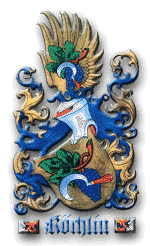
Philip Keithland, c 1747-aft 1792
Keithland, Keithline & Cathline
This tree is developed from “The Keithlines in U.S. & Canada” by Ralph B, Cathline, over the period 1970-1980. This “tree” goes back into Europe and later Pennsylvania. This document extracts the Keithlines, Keithland and Cathlines that began in Current New Brunswick with the landing in 1783, of Philip Keithland in the present area that is known as Saint John, NB. This extract was done in 1999 and updated by Ralph, Glenna, and Norma,in later years, to include all known descendants of Philip Keithland.
Philip Keithland arrived with the Loyalists in June or July,1783. There is no mention of his Wife, but a Son & Daughter, and two others under 10 years of age are listed. This was found recently by Ralph, in a book by D.G. Bell, “Early Loyalists of Saint John”, New Ireland Press, 217 Aberdeen Street, Fredericton, N.B.
It has a1so been told to Ralph in April 1997, by the late Julia Walker, that an insertion in a Family Bible, owned by an Archie Gates, that said “Mary Ann Cathline 1775-1851 m, David Alston Dunham, 1762-1845”.
Mrs.Marian R, Hart in her Supplement to “The Kichlines in America” mentions that Johann Peter, bNov.8th, 1722, had three sons, so it was presumed by this Compiler (RBC) that Philip, b about 1745-7, who travelled to Saint John, N.B. in May 1783, with family, as a Loyalist, was the Son of Johann Peter, and probably classed by his kinfolk as disloyal, by aiding, or joining the British. p.d. “The Cathline Family Tree,” 1970-1980. However, Ralph’s assumption that Peter must be Philip’s father has no basis in genealogical proofs. Furthermore, at least four sons of Peter’s are already documented. Peter Jr. (1750), Andrew (1751), Jacob (1758), and Charles (1760) — CEB.
That Philip was loyal to the British has been well documented; from Series II vol. II page 434 of the New Jersey Archives, Newspaper Extracts:
WHEREAS Inquisitions were found the 20th day of June 1778, against the following persons who have joined, sided, or assisted the army of the King of Great Britain in the present war against the American States, viz. Joseph Beer, Christopher Ainslie…PHILIP KICKLINE,… Thomas Turpan, late of Mansfieldwoodhouse; in the county of Sussex; which inquisitions were returned at the last session holden in said county,and proclamation made in open court according to law; and if the persons against whom inquisitions have been so found, or some persons in their behalf,will not appear at the next court holden in the aforesaid county,and traverse the inquisitions,final judgments will thereupon be entered in favor of the State.
Given under our hands this 5th day of September, 1778
WILLIAM BOND, }
GEORGE WARNER, }) Commissioners
From Series II Vol. III pages 46, of the New Jersey Archives:
Notice is hereby given to all persons who have a claim, interest, or demand to, in or against the estates of James Stuart, Christopher Insley, Joseph Bear,…PHILIP KIGHLINE,…and Thomas Turpin, to appear with their accounts, and evidence before the subscribers, in Greenwich, on or before the first day of March next ensuing, then and there to have the same adjudged and settled.–And a11 persons indebted to the above persons, are desired to make speedy payment to the subscribers; and any person possessed of any moneys, bonds, bills, notes, mortgages, books of accounts, and any instruments of writing whatsoever,belonging to either of the above persons,and do not make discovery thereof to the subscribers within one month after this publick notice has been given, shall, if convicted thereof, forfeit treble the value of such property as sha11 be by them so detained,– And all persons indebted to the subscribers for goods bought at the severa1 vendues, are desired to make speedy payment to prevent trouble.
WH.LIAM BOND, }
GEORGE WARNE, } Commissioners, Sussex County, Dec.10, 1778.
P.287, “The Loyalists of New Jersey in the Revolution”: In a list of the Loyalists of New Jersey in thc Revolution: Kichline, Philip,Sussex Co.judgement, (2N.E.435, 3N.E.46)1778
From “Collections of the New Jersey Historical Society, Vol.X. “The Loyalists of New Jersey”, by E.Alfred Jones,p.254.appendix 3 by A.Van Doren Honeyman, Plainfield, N.J. ,”When the peace came, thousands of Loyalists went to Nova Scotia or the Province of New Brunswick.”
THE CATHLINE FAMILY TREE as seen and heard by Ralph B. Cathline, August 1970-1980
KEITHLAND – KEITHLINE – KATHLINE – KATHALINE – CATHELINE – CATHLINE. Pronounced KETHLYNN in the 18th century, and now pronounced in New Brunswick.and Ontario as KATH-LINE.
P.6: On may 18th, 1783,PHILIP KETHLAND and his Family arrived at the mouth of the Saint John River, in the British Colony of Nova Scotia, later ( July 1784) to be divided into two Provinces: New Brunswick was now born! It is presumed that they were part of the “Spring Fleet” of Loyalists out of Long Island, New York. ( In Norma’s research recently, she found that Philip and his Family came in Unit #27 on the ship called Lord Townsend, in June or July of 1783.)
PHILIP brought with him his Wife and Son Joseph, age 11 years. In later research, it was found that a daughter, Mary Ann, about 8 years old, and two other under 10 years old. It was not an easy life in the new Colony, as it was just a wilderness, except for a few Acadian settlers. It was not known whether Philip was a soldier in one of the Loyalist Regiments or a farmer, but stories have been handed down, how he,as a young man in the Schulylkill River area, of the then British Colony of Pennsylvania, killed a large rattlesnake with a stick, and hung it on a branch of a tree. It was as large as a man’s arm and both head and tail touched the ground, as it draped over the tree branch, and people came from miles around to see it!
Philip was a big man and strong as an ox, like most of his decendants of today. It has been said that he received a Grant of land from King George III, in the vacinity (sic) of what is now Market Slip, but no record could be found to substantiate this.
P.7 Philip and his family moved on up the St. John River to the Kennebecasis Bay, and choose an Island that was named Long Island after the one in New York State. While Philip’s wife was busy having children,(6) in all Philip and his son Joseph built shelters, trapped, and caught fish, and hunted, to supplement the Royal Bounty of provisions issued by the Commissary, to all the Loyalists who required them.
This period of time was very hard on all the Loyalists, who left the various British Colonies after the American Revolution, because of there beliefs,and loyalty to King and Country. They had given up their homes, businesses, and many loved ones, to settle in a new land, as told by Esther Clark Wright in her book “The Loyalists of New Brunswick”. A book by Stuart Truman, “The Ultimate History Of New Brunswick”, also tells of the hardships endured by the Loyalists.
On May 12th. 1786, Philip received a Grant of land where he was living, being Lot No. 27 on Long Island, in the Kennebecasis Bay, in the Messrs. Thomas Wetmore Survey, Grant No. 37 to one Henry Betner and 36 others, alloted in the Old Register by the Governor in Council.
Philip’s next child was Ann, born 1784, a year after they arrived in the new Colony; then came Nellie, about 1786, and Catherine, 1788; Jacob, 1790 and Elizabeth, 1792.
As time went by and the house was built, the land cleared, and the crops put in, the children soon grew. Education was at a minimum, and the first school to be recorded was in 1841, from information supplied by Julia Redmore Walker, in which an Archive document listed Michael Penistan as the teacher, with instructions given in Reading and Writing, using Spelling book, New Testament, and Roman Catholic Catechism.
P.8 The name “KEITHLINE” changed many times through the years, namely due to Swiss Ancestry, and was Anglicized, as it was spelled as it sounded by those who wrote it.
VARIOUS SPELLINGS OF KEITHLAND:
CATHELINE – CATHLINE – KACHLEINE – KATHALENE – KECHLIEN – KEICHLINE – KEIGHLINE – KEITHLINE – KICHLIN – KEUCHLINE – KIGHLINE – KOCHLINE – KOECHLINE – KOCHLIN – KUECHLINE – KUECHLIN – and many others!
 Cathline Family Tree